
Advanced Sputtering System for PowderSputtering equipment is a PVD-type thin film forming equipment that utilizes the sputtering phenomenon in which ionized Ar gas under plasma discharge collides with a target at high speed, and target atoms ejected by the collision are deposited on the substrate.

SSP1500B
Compact tabletop parallel plate magnetron sputtering system for powder
POINT
- Equipped with a slant-rotating sample holder
- It is capable of film deposition while stirring powders
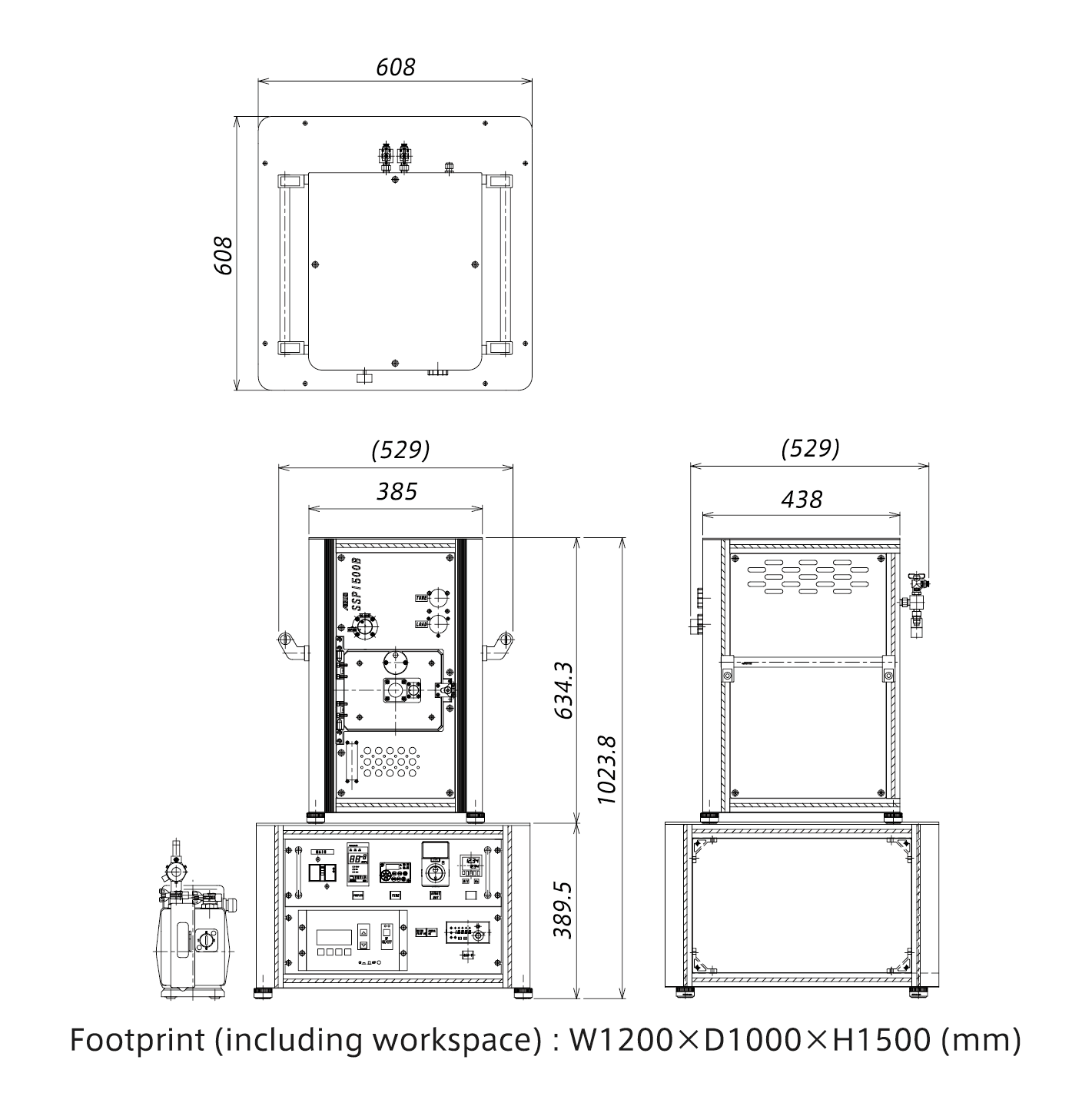
Outer dimensions (Main unit)
W385mm × D438mm × H635mm
| Cathode | Substrate heater | Combination |
|---|---|---|
| 1 piece | Not Applicable | × |
Powder x Deposition → PowderGenic
SUGA, CO., LTD, we focus particularly on the integration of powder technology and film deposition technology among the various technologies we handle.
We refer to the range of technologies and products resulting from this integration as “PowderGenic.”
Specifically, we use PVD sputtering and ALD (atomic layer deposition) to form thin films on the surfaces of powders, thereby imparting new functions to the powder materials.
That is our vision of “PowderGenic.”
Case Study
In research on thermoelectric conversion materials conducted by a joint research team from the National Institute for Materials Science (NIMS) and the University of Tokyo, our SSP1500B was used in the Pt (platinum) coating process on the surface of YIG (yttrium iron garnet) powder. In this research, our exceptional technology for uniformly sputter-coating powder surfaces at the nanoscale contributed to the demonstration of a new thermoelectric conversion structure (trans-scale spin Seebeck effect) that utilizes spin current in insulators.
The research findings were published in ‘Nature Communications’ on July 21, 2026.
For details, please check the NIMS press release (https://www.nims.go.jp/press/2026/07/202607210.html) and the article (DOI: 10.1038/s41467-026-75232-0) (https://www.nature.com/articles/s41467-026-75232-0).
Outline・Application
SSP1500B the compact sputtering system for powder, offering high performance and high quality.
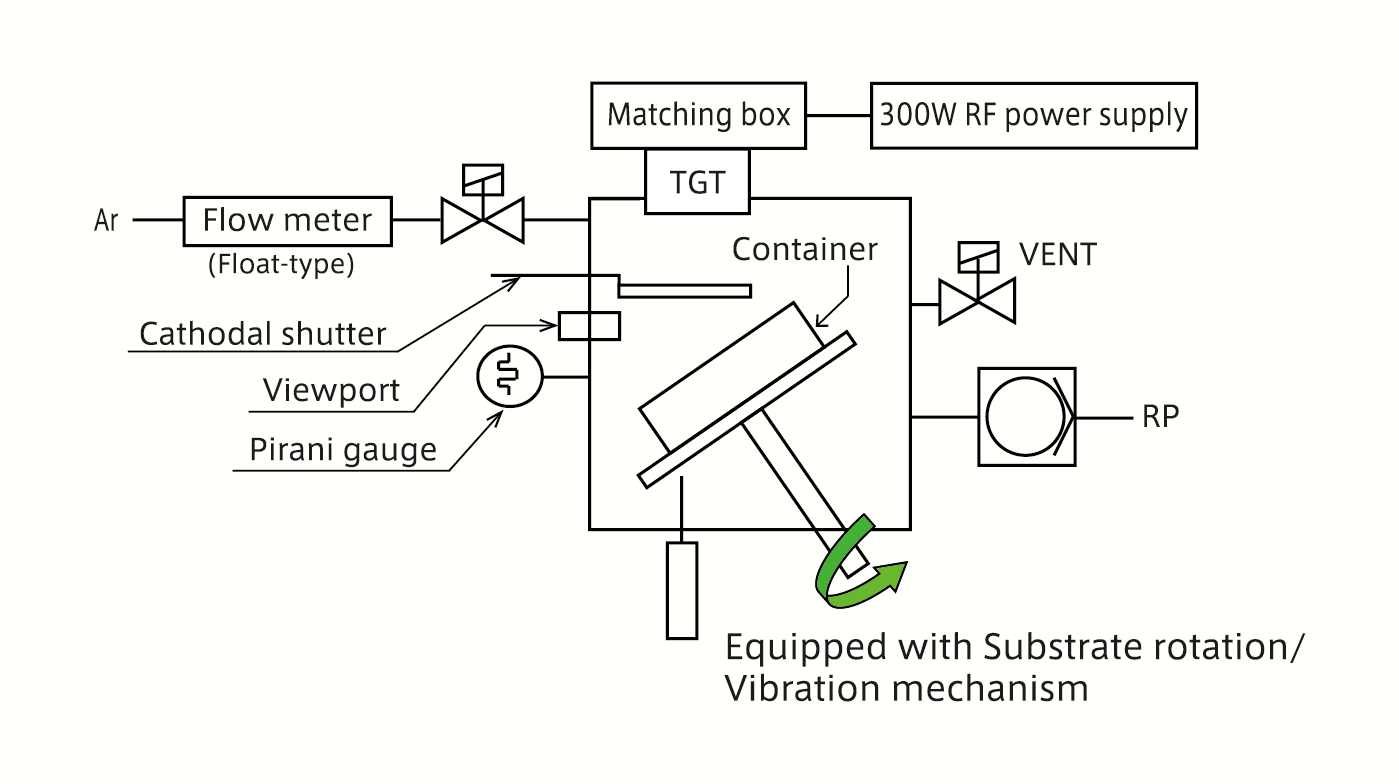
It achieves film deposition onto powder surfaces by rotating and vibrating the powder within the sample dish.
Equipped with RF generator, it’s applicable not only for metal target but also insulating target.
Features
Feature1:Versatility
・Our unique petri dish, tilting rotation mechanism, and vibration mechanism enable adaptation to diverse specifications.
・Optional magnet replacement enables compatibility with magnetic targets.
Feature2:Performance
・Equipped with a 2-inch cathode with a cathode shutter for non-magnetic targets.
・Equipped with the pulsed RF generator as standard, it enables deposition even on insulating targets prone to abnormal discharge.
Feature3:User Friendly
・It can be placed on the desk thanks to its compact design.
・Exhaust operation is fully automated.
・Equipped with an anti-deposition shield plate inside the chamber and a viewing window (with shutter and shield glass).
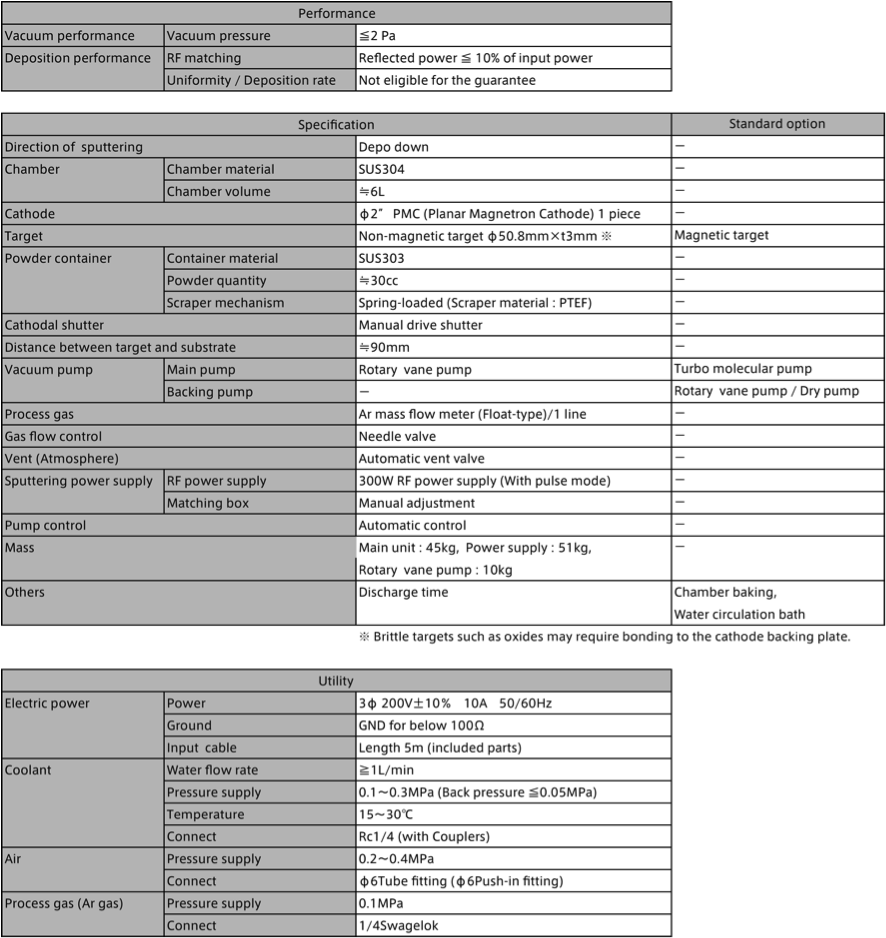
SSP1500B Specification
SSP1500B Outer dimension
TECHNOLOGY
SUGA’s Sputtering Equipment
Sputtering equipment is a film-forming equipment that uses sputtering method, which is classified as physical vapor deposition (PVD) within the category of vacuum thin film formation. Thin films obtained by sputtering equipment have excellent adhesion to substrates, high reproducibility during repeated film formation, and the ability to produce high melting point materials and alloys. It is also possible to produce oxide and nitride films as well as metal films and insulating films that are indispensable for functional materials such as semiconductors and electronic devices.
SUGA Co., Ltd. has applied technology and strict quality standards that has been accumulated over many years as a partner company of a major vacuum equipment manufacturer to its own brand equipment which makes it possible to design and manufacture user-friendly, robust, high quality sputtering equipment to meet the customer’s needs.
Feature of sputtering
• Since the impact energy of the material that collides with the substrate is strong, a thin film with high adhesion can be obtained.
• Since the material flies linearly in a certain direction, the film adheres less to other than the substrate compared to the conventional deposition methods. However, a film is difficult to adhere to the side wall surface of the uneven portion.
• Film thickness can be easily controlled by adjusting various conditions such as power supply and deposition time.
• A film with a uniform thickness can be formed over a wide area.
• High melting point materials and insulating films can be formed.
• When making an alloy, the composition of the material is less likely to be changed compared to a vapor deposition that melts the material at a high temperature.
• Compound film also can be obtained by reactive sputtering combining nitrogen, oxygen, hydrogen, etc.
• Deposition surface of the substrate can be plasma cleaned (reverse sputtering) by applying high pressure to the substrate holder.
• The deposition speed (deposition rate) is slower than the vapor deposition.
The structure and principle of the sputtering equipment
01.Vacuum chamber
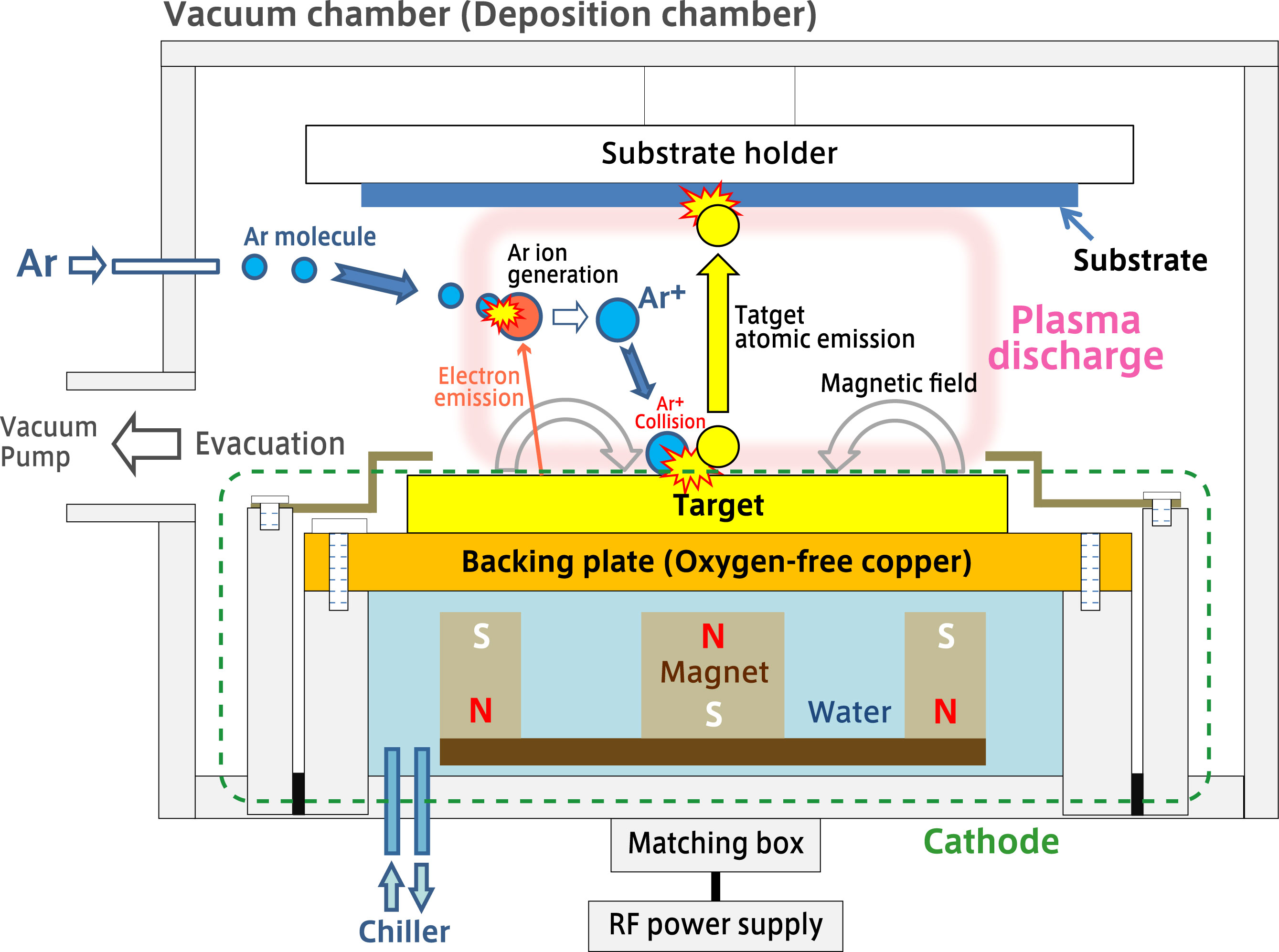
The cathode (electrode) for mounting the target material and the substrate (wafer) are placed to be opposite in the vacuum chamber. The distance between them is about several tens to hundred mm.
The figure shows an example of sputter up (face down) in which the deposition direction is from bottom to top. The sputter-up arrangement has two advantages: it prevents foreign material to adhere to the substrate surface, and the cathode side with a water cooling mechanism is easy to maintain.
Sputter down (face up) arrangement with the mechanism turned upside down is useful for film deposition that cannot be fixed.
A sliding shutter plate is placed between the cathode and the substrate so that the film formation timing can be controlled.
02.Cathode
SUGA Co., Ltd. employs PMC (Planar Magnetron Cathode) system. The green dotted line in the figure explains collectively called the cathode.
An oxygen-free copper back plate (backing plate) is placed on the back of the sputtering target, which is the film forming material. Although many metal-based targets can be deposited properly when it’s placed on a backing plate, compound targets are often required “bonding process” to bond to the backing plate in order to increase cooling efficiency and prevent cracking and breakage of the material.
Whole series of services are available from target arrangement to bonding processing.
A water-cooled permanent magnet is placed under the back plate. A ring-shaped magnet and a cylindrical magnet are fixed to the base of the disk (Yoke) although the figure appeared to be showed that three magnets are arranged. A circular tunnel is formed on the target where the magnetic field generated by the magnet and the electric field generated by the application of voltage are orthogonal to each other, and a high-density plasma discharge is generated in this area.
03.Vacuum, and Ar gas
To generate plasma discharge, first evacuate the vacuum vessel (film formation chamber). In general, 0.2~10Pa is good enough for plasma discharge but for the purpose of producing high-quality thin films, it is desirable to reduce the gas components (outgas) released from the inner walls and structures of the equipment under vacuum as well as residual gas typified by water present in the deposition chamber as much as possible
Therefore, a turbo molecular pump is employed that can reduce pressure to the high vacuum range. Depending on the specifications of the equipment and pump, a certain amount of time will be required to obtain 10-5 Pa or even lower.
After reducing the pressure to the ultimate vacuum, keep the pressure at about 0.5Pa after plasma excitation while introducing a high-purity argon gas.
The reason why argon gas is used in the sputtering equipment is that the sputtering rate is relatively good and the inert gas should make it difficult for chemical reactions with other materials to occur. Argon is also popular because of its high purity and low costs.
N2 and O2 may be used for reactive sputtering other than argon. Rare gases such as He, Ne, Kr, and Xe may be used for other purposes.
04.Plasma discharge
By RF sputtering power supply, voltage is applied to the cathode and electrons emitted from the target surface collide with floating argon molecules. Electrons are knocked out of the argon molecules by collision and Ar + ions are generated. Electrons have the property of flowing into the conductive body, but there is no escape near the target under the plasma. As a result, the density of plasma increases near the magnetic field above the target, and Ar + ions are generated efficiently.
Ar + ions, which are accelerated by an electric field under plasma, fly and collide at high speed (thousands of kilometers per second) toward the cathode surface. The phenomenon that Ar + ions blow off target atoms is called sputtering.
The atoms on the cathode surface are sputtered by collision with Ar ions, and collide at high speed (10,000 km per hour) at the opposite substrate side. A thin film is gradually formed on the surface of the substrate due to repeated collisions of atoms of the target material. Since atoms collide with strong kinetic energy on the substrate surface, the thin film formed by sputtering equipment has excellent adhesion.
05.RF power supply
As the standard, SUGA Co., Ltd. employs RF power supply for its Sputtering equipment. RF sputter is equipped with a 13.56MHz high frequency AC power supply (RF power supply) and matched in the matching box, and discharged while switching the anode and cathode at high speed.
For insulating target material, discharge does not last in DC power sourced sputtering equipment whereas RF power sourced sputtering equipment can stably maintain plasma and has better flexibility. In addition, since an RF power supply with a pulse function is adopted as standard, insulation targets that are prone to abnormal discharge can be also handled.
Please get the local consultation for the installation of high frequency wave equipment.
Send us an inquiry if you have any questions.