
SECM (scanning electrochemical microscopy) is a type of SPM (scanning probe microscopy).
If you would like to know more about SPM, please read the following article, which also explains it.
This article will explain some examples of how SECMs work and the situations in which they are used.
We are pleased to share insights that only those of us working with atoms on a daily basis can provide. We hope you find this information useful.
Let’s look at it.
SECM (scanning electrochemical microscopy) is a microscope that uses microelectrodes to make measurements.

SECM (scanning electrochemical microscopy) is a microscope that uses microelectrodes as probing needle to obtain reaction images of chemicals on the surface of a sample and quantification of reaction rates.
SECM is a type of SPM (scanning probe microscopy), mainly used in genres ranging from corrosion protection chemistry to enzyme stability studies.
Example of structure of SECM (Scanning Electrochemical Microscopy)
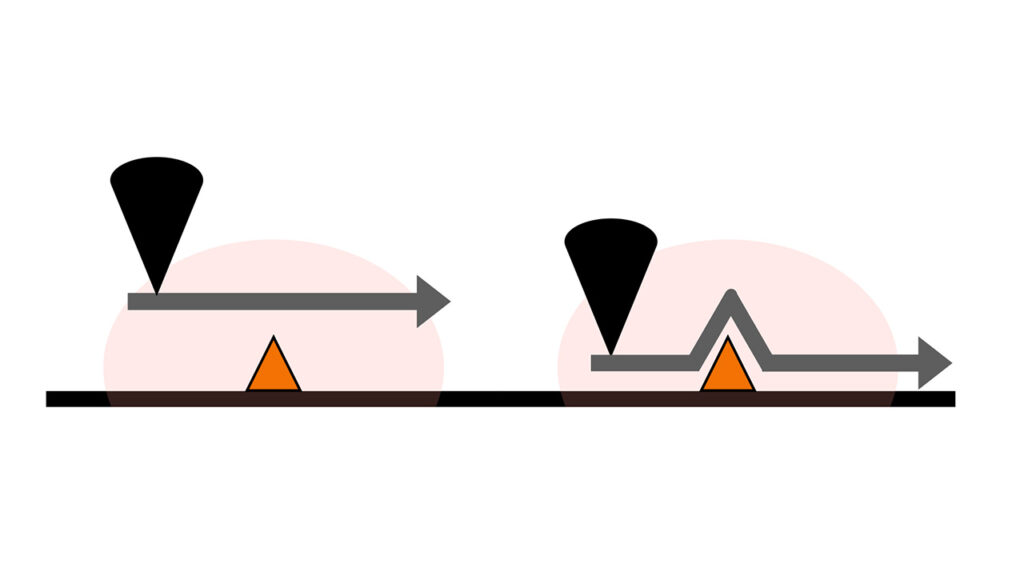
Left:Constant height mode
Right:Constant Distance Mode
There are several modes of SECM. Here, we will look at an example in the ‘probe scanning method’, which is easy to compare with other SPMs.
The SECM probe scanning method has two modes.
・Constant height mode: Relatively simple to perform (no special electrodes or feedback control required)
・Constant Distance Mode:Close to tens of nanometers for high resolution and contrast imaging
The most commonly used measurement is the relatively simple ‘constant height mode’.
Constant height mode is a method of measuring surface topography by maintaining a constant height between the electrode and the sample.
However, there are weaknesses, such as the inability to accurately image irregularities unless the tip of the electrode is placed above the highest point in the imaging range.
Therefore, constant distance mode is used if the user wants to obtain accurate geometry with higher resolution and to detect electrochemical activity at the same time.
The constant distance mode is an electrical version of the conventional SPM method.
Real image samples from SECM (Scanning Electrochemical Microscopy).
SECM image obtained by scanning over a 100 micron diameter platinum disc electrode in ferrocene ammonium solution.
The current in the platinum area is greater, so it is projected as a mountain.
For a sample of the actual image, please see the following pages.
Principles of SECM (in Japanese)
History of SECM (scanning electrochemical microscopy)

Microelectrode measurements have been made since around 1980.
Then, developing the SPM technique, the SECM is reported by A.J. Bird et al. in 1989.
With its SPM aspect and electrochemical measurement aspect, the SECM has become one of the microscopes that continue to be used in recent years.
Summary
We talked about SECM (scanning electrochemical microscopy).
Finally, let’s look back at the key points.
・SECM (scanning electrochemical microscopy) is a microscope that uses microelectrodes to make measurements.
・SECM probe scanning methods include ‘constant height mode’ and ‘constant distance mode’.
・SECM was developed in 1989 with the development of SPM and is still in use today.
We mentioned at the beginning that SECM is a type of SPM (scanning probe microscope).
For more information on SPM, see also the following article.