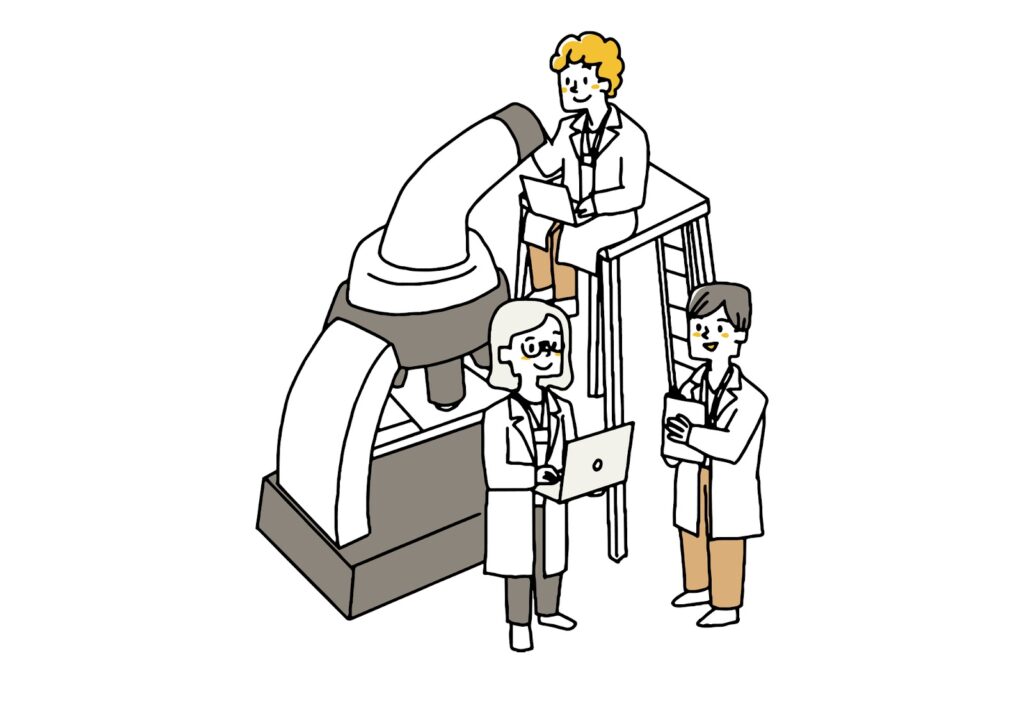
SPM (scanning probe microscope) is used for surface profile observation.
There are several types, each with different characteristics.
This article will explain SPM itself and its types, how it is used in society and the history of when it was first used.
We hope that you will find this information useful, as we can only provide it because we are usually involved in work related to atoms.
Let’s look at it.
SPM (scanning probe microscope) is the generic name for a new type of microscope.

SPM is a general term for microscopes that use a tiny needle (probe) to detect surface irregularities on a sample.
As of 2022, three main types of microscope are widely used: optical microscopy, electron microscopy and SPM (scanning probe microscopy). (There are also X-ray microscopes and ultrasound microscopes, but these are still of limited use).
As can be seen from the fact that SPM is a generic term, there is a detailed classification.
The two most commonly used types are STM (scanning tunneling microscope) and AFM (atomic force microscope).
The differences between them are discussed in the next section.
Types of SPM (scanning probe microscope)
There are two main types of SPM commonly utilised: STM and AFM.
Let us introduce each of them to you.
STM (scanning tunneling microscope)

STM uses tunneling currents to detect irregularities in a sample.
It is one of the oldest SPM microscopes and has been in use since its development in 1981.
For more information, see also the following article.

STM has the disadvantage that it can only measure conductive materials because it uses tunnel current.
This led to the development of the AFM (Atomic Force Microscope), which will be introduced next.
AFM (Atomic Force Microscopy)

AFM uses atomic forces instead of tunneling currents to detect irregularities in a sample.
This has greatly expanded the possibilities of SPM, as non-conductive materials can now also be measured.
If you would like to know more about AFM, please read the following article, which also explains it.

Other types of SPM include the following.
MFM: Magnetic force microscope.
SNOM: Scanning near-field optical microscope.
SECM: Scanning electrochemical microscope.
How SPM (Scanning Probe Microscopy) is used in society.
SPM can measure at the nano-level.
Specifically, they are used in the following areas
DNA observation

SPM can be used to observe DNA as it can measure at the nano-level.
DNA can be observed to help elucidate diseases and other conditions in the medical field, and to confirm the authenticity of the labelling of varieties in the food sector.
SPM is useful in unexpected and familiar places.
Precise measurement of surface roughness of semiconductors, etc.
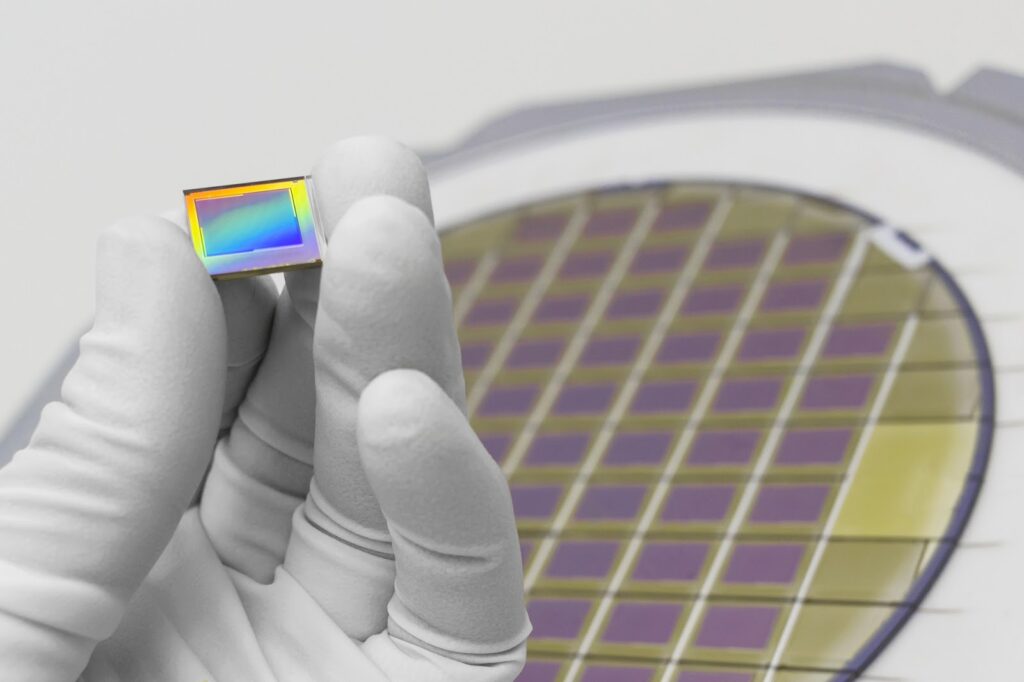
SPMs are also used during precision measurements of surface roughness, e.g. on semiconductors.
The unevenness of the machined surface of a component is known as ‘surface roughness’.
Components with high surface roughness have irregularities, causing light reflection to become dull.
Furthermore, surface roughness affects not only appearance and tactile feel but also wear rates and sealing performance, making its accurate measurement crucial.
History of SPM (scanning probe microscopy)
SPM is a relatively new microscope invented in 1981 by Dr ‘Gerd Beinig’ and Dr ‘Heinrich Rohrer’ at the IBM Zurich Institute.
In 1981, STM (scanning tunneling microscope) was invented, a revolutionary invention that not only measured surfaces but could also process individual atoms.
As a result, both were awarded the Nobel Prize in Physics in 1986.
However, due to the shortcomings of STM, which could measure only conductive materials, the AFM (Atomic Force Microscope) was invented in 1986 by Dr ‘Gerd Beinig’ and Dr ‘Calvin Quart’, and has been used to this day.
Summary
We explained about the principles and types of SPM in this issue.
Finally, let’s look back at the key points.
- SPM is the generic name for a new type of microscope that uses a needle (probe) to observe irregularities on the surface of a sample.
- There are two main types: ‘STM (scanning tunneling microscope)’ and ‘AFM (atomic force microscope)’, with AFM more often used.
- SPM can be used for ‘DNA observation’ and ‘sealing measurement of surface roughness of semiconductors and other materials’.
- 1981 STM developed, 1986 AFM developed