Recently, the term ‘lithium-ion batteries’ has been seen and heard frequently on TV and in newspapers.
Although research and development is underway in many countries for use in electric vehicles (EVs), perhaps few people know what a lithium-ion battery is in the first place.
This article explains how lithium-ion batteries work, their lifespan, advantages and disadvantages.
We hope this helps to resolve any questions you may have about lithium-ion batteries.
Let’s look at them.
What is a lithium-ion battery?
A lithium-ion battery is a battery in which lithium ions (Li+) move around inside the battery as carriers of electricity.
They are called lithium ‘ion’ batteries because they always exist in an ionic state during the charge-discharge reaction.
Lithium-ion batteries are rechargeable.
Once fully discharged and the energy extracted is exhausted, electrical energy can be stored and used again if the battery is recharged.
Lithium-ion batteries have rapidly gained market share in the rechargeable battery market since Sony and Asahi Kasei successfully commercialized them in 1991.
Structure
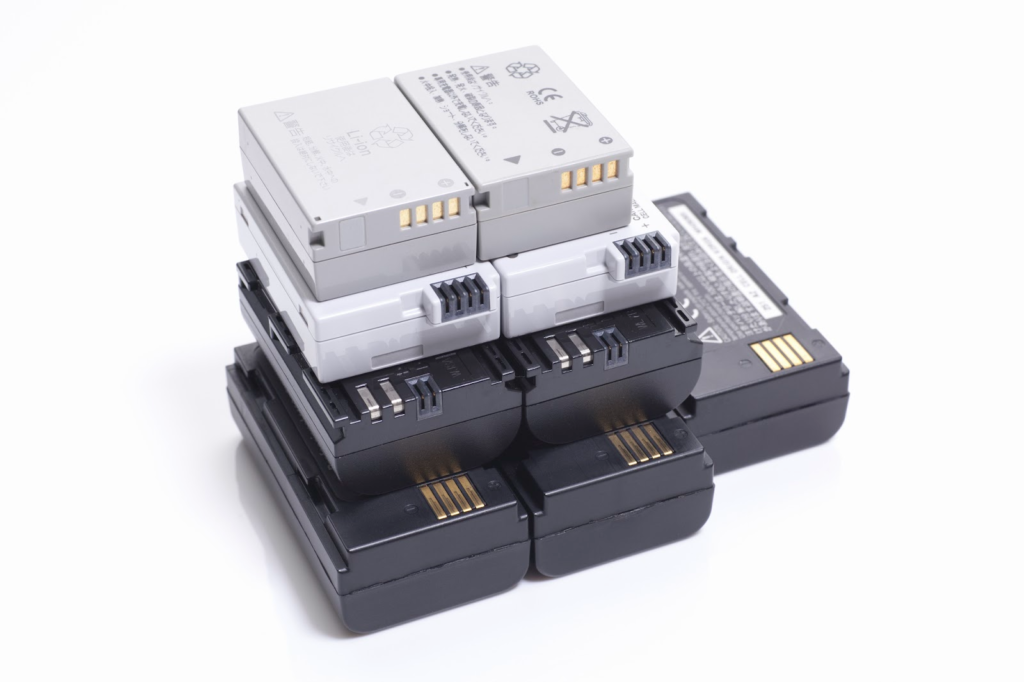
Lithium-ion batteries mainly use LiCoO₂ (lithium cobaltite) for the positive electrode, C (carbon) for the negative electrode and organic electrolytes containing lithium ions such as LiPF₆ (lithium hexafluorophosphate) for the electrolyte.
During charging, lithium ions (Li⁺) are desorbed from the positive electrode and absorbed into the carbon of the negative electrode.
- positive electrode: LiCoO₂→Li(1-x)CoO₂+xLi++xe‐
- Negative electrode: 6C+xLi++xe‐→LixC₆
Conversely, during the discharge reaction, the absorbed Li⁺ is desorbed from the anode and reabsorbed back into the cathode.
- Positive electrode: Li(1-x)CoO₂+xLi++xe‐→LiCoO₂
- Negative electrode: LixC₆→6C+xLi++xe–
As Li+ only comes and goes in the charge-discharge reaction, lithium-ion batteries are also known as ‘rocking-chair batteries’.
In recent years, new materials such as manganese and phosphate as cathode materials and silicon as anode materials have been investigated.
Further improvements in energy density and cycle properties are also expected for electrolyte, such as improved charge-discharge performance due to higher concentrations.
Characteristics
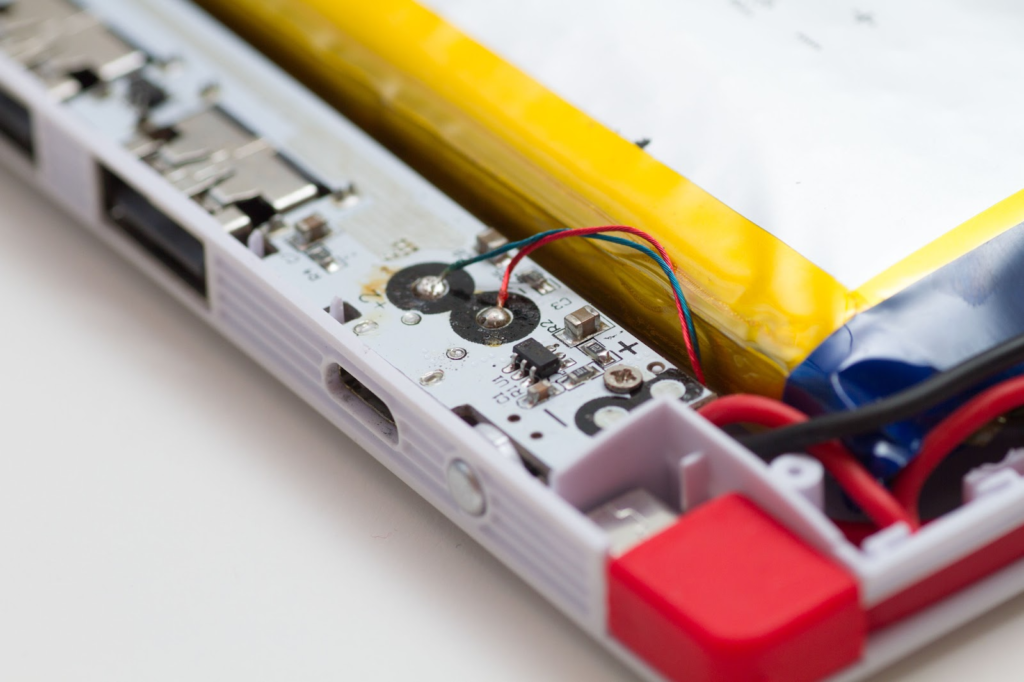
Lithium-ion batteries are characterized by two main features.
- High output voltage and energy density
- No memory effect.
Let’s look at them, one by one.
High output voltage and energy density
The nominal voltage of lithium-ion batteries is 3 V or higher.
High voltages are indicated at one terminal.
Equipment requiring high voltages for operation can be run with fewer stacks, reducing the volume occupied by batteries in the equipment.
They are also superior to other rechargeable batteries in terms of energy per weight and weight energy density [Wh/kg].
If lithium-ion batteries are used as a replacement for other batteries, this can lead to a reduction in the overall weight of battery-powered equipment.
No memory effect.
Lithium-ion batteries do not have a memory effect that temporarily reduces their capacity.
They can be used and charged more freely than other rechargeable batteries and are less likely to cause problems such as sudden equipment stoppages.
In addition, even if they are left unused, the natural discharge rate is only a few per cent per month, which is one tenth that of NiMH batteries.
These characteristics make them suitable for use in disaster-prevention products.
life span
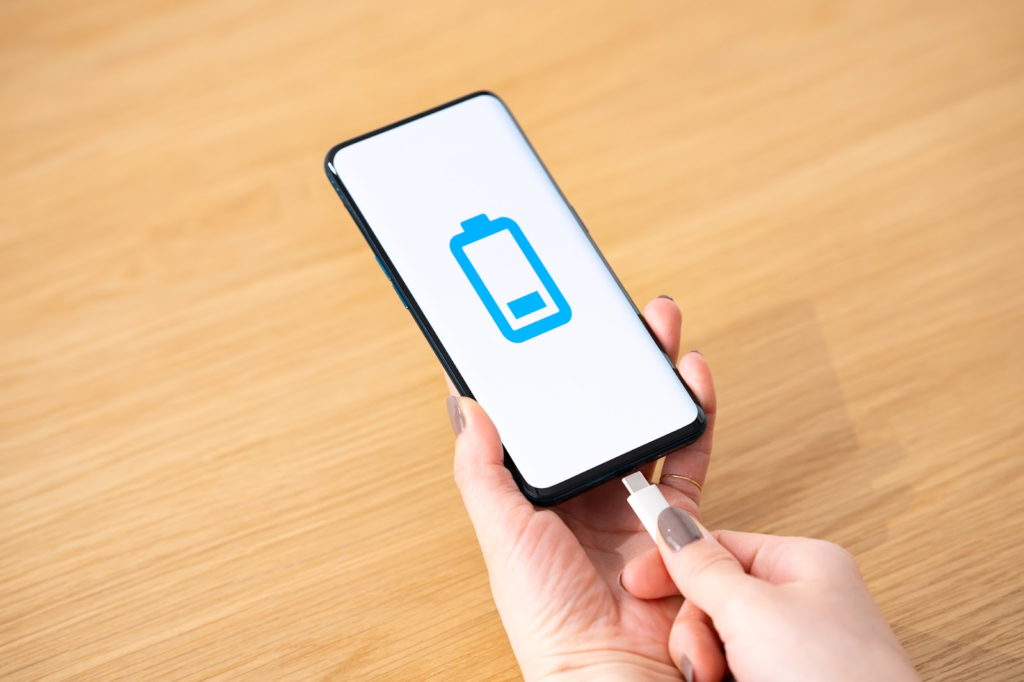
The life of a lithium-ion battery depends on the environment in which it is used, but is said to be around 300-500 cycles for a smartphone battery.
The greater the charging speed, the faster the battery deteriorates and the less capacity it can store when fully charged.
Factors that may hasten the life of lithium-ion batteries include,
- Frequent use.
- Using while charging.
- Leaving it empty for a long period of time.
These are the factors.
In order to extend battery life, it is necessary to review the frequency and conditions of use.
Examples of lithium-ion battery applications
Lithium-ion batteries are currently used in portable devices such as smartphones and laptops.
Recently, research and development has been actively carried out with the aim of installing them in EVs and other transport equipment, and they are also expanding their activities into the space sector, for example in satellites.
Storage batteries are essential for the efficient use of renewable energy sources with unstable output.
As lithium-ion batteries become less expensive, they could be integrated into the electricity grid.
Disadvantages of lithium-ion batteries
The disadvantage of lithium-ion batteries is that they present safety issues.
The use of flammable organic electrolyte in the electrolyte can lead to ignition accidents when both electrodes short-circuit in the battery.
In addition, the recycling system for lithium-ion batteries is not yet fully developed, which poses a major challenge when disposing of batteries after use.
The current need to recycle materials within lithium-ion batteries is becoming increasingly important, as the volume of battery production will increase significantly when lithium-ion batteries are installed in EVs.
Lastly
This concludes the explanation on lithium-ion batteries.
We hope that we can answer some of the many questions you may have about batteries.
References
リチウムイオン電池の科学―ホスト・ゲスト系電極の物理化学からナノテク材料まで (材料学シリーズ) 工藤 徹一, 本間 格, 日比野 光宏、内田老鶴圃
リチウムイオン電池 – パナソニック (panasonic.com)
電池の基本構成と充放電の原理:知っておきたい 電池の仕組み(2)(4/6 ページ) – EDN Japan (itmedia.co.jp)
リチウムイオン電池・次世代電池における最新の観察と解析 | 電子デバイス業界 | マイクロスコープ拡大解析事例 | キーエンス (keyence.co.jp)
超5 Vリチウムイオン電池の実現-高電圧作動時の劣化を抑制-|【工学部/工学系研究科】 プレスリリース | UTokyo-Eng (u-tokyo.ac.jp)
充電式電池のメモリー効果とは?(メモリー現象とは?) PZ18111 – ニッケル水素電池&充電器 – Panasonic
リチウムイオンバッテリーの自己(自然)放電とは?基礎・基本を学ぶ – 株式会社 長谷川製作所 (e-hasegawa.co.jp)
第5回 リチウムイオン電池が持続可能(サステナブル)な社会の実現に貢献する理由とは?鉛蓄電池から置き換えるメリットやリサイクル方法、未来の可能性を解説 | 村田製作所 技術記事 (murata.com)