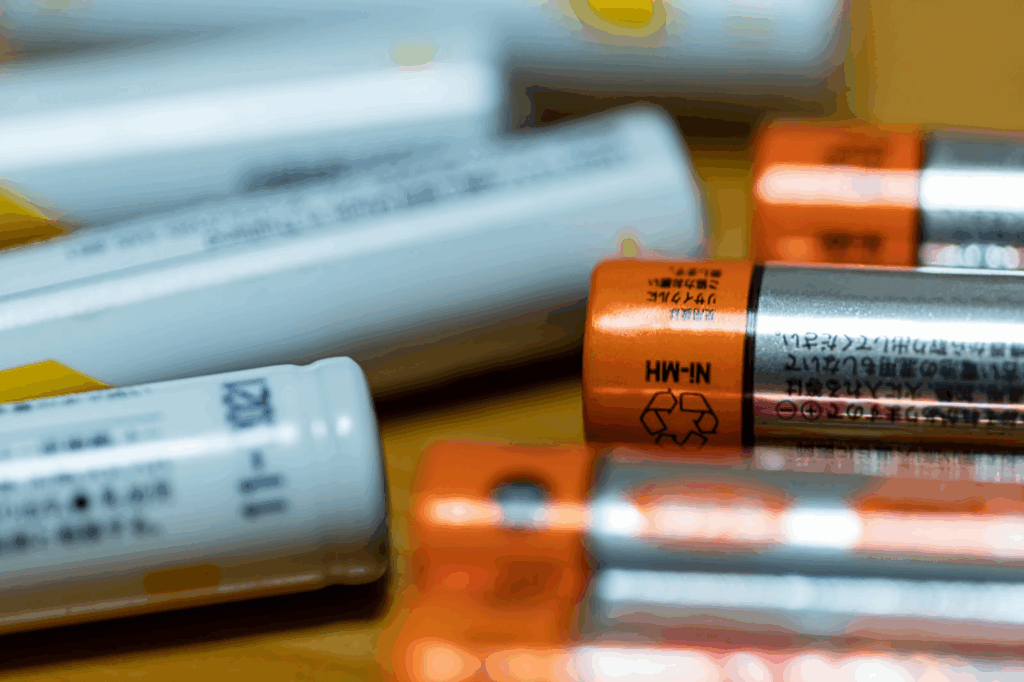
There are so many batteries around us, but one of the most frequently seen batteries is probably the nickel-metal hydride battery.
However, many of you may have heard of them, but don’t actually know much about them…
This article therefore describes nickel-metal hydride batteries.
We hope that you will read this article to the end, as it explains how it works, its features and examples of its use.
Let’s look at them.
What are nickel metal hydride batteries?
Nickel-metal hydride batteries are batteries in which nickel hydroxide and hydrogen storage alloys are used in the battery.
The structure replaces the cadmium in the nickel-cadmium battery with a hydrogen storage alloy, making it a rechargeable that can be used again even after the energy has been extracted.
Structure
Nickel-metal hydride batteries use nickel oxyhydroxide (NiOOH) for the positive electrode and a hydrogen storage alloy (MH, where M is metal) for the negative electrode.
During charging, hydrogen desorbed from the anode is absorbed by the cathode.
- negative electrode: M+H2O+e–→MH+OH–
- positive electrode: Ni(OH)2+OH–→NiOOH+H2O+e–
Conversely, during discharge reactions, the absorbed H atoms are desorbed from the cathode and reabsorbed back into the cathode.
- negative electrode: MH+OH–→M+H2O+e–
- positive electrode: NiOOH+H2O+e–→Ni(OH)2+OH–
The electrodes have high chemical stability as no electrode dissolution/precipitation reactions occur during charge/discharge reactions, which contributes to longer battery life and improved safety.
Hydrogen storage alloys for the anode are made from a combination of metals that easily absorb hydrogen (such as lanthanides, cerium and indium) and those that do not (such as nickel, cobalt and aluminium).
By blending these in the right proportions, the alloy can store more than 1,000 times its own volume in hydrogen.
Characteristics
Nickel-metal hydride batteries have the following three characteristics.
- Large power output for extended periods of time.
- Can be used in place of dry cell batteries.
- Resistant to overcharging
Each of these is explained one by one.
Large power output for extended periods of time.
They have lower internal resistance than other rechargeable batteries and can carry a larger current during discharge.
It is used in situations where high power output is required, such as when powering the motors of radio-controlled cars and hybrid vehicles.
Can be used in place of dry cell batteries.
They have a low voltage per terminal and are used as an alternative to dry cell batteries.
Because they are rechargeable batteries, they can be used repeatedly by recharging them even when their capacity has been depleted, making them superior to primary batteries in terms of long-term cost-effectiveness.
Resistant to overcharging
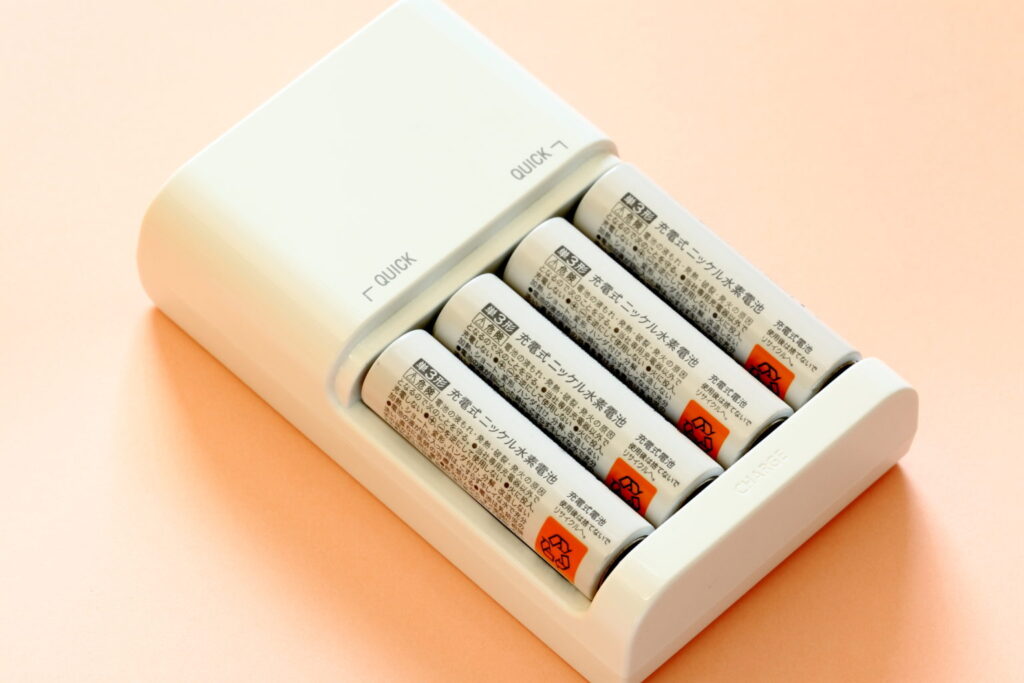
The anode is designed to be larger than the cathode, so that if gases are generated in the cathode, the anode absorbs them.
This reduces the pressure build-up in the battery when overcharged. Even in the unlikely event that the battery can no longer fully absorb the gas, a mechanism that releases the gas through the battery’s safety valve helps prevent the battery from rupturing.
Life span
Depending on the conditions of use, typical nickel-metal hydride batteries, such as Panasonic’s Eneloop and Evolta, can be charged and discharged for approximately 500-1000 cycles.
Factors that accelerate the life of NiMH battery cells include,
- Frequent use.
- Using while charging.
- Leaving it empty for a long period of time.
If the battery is used in a way that damages it, such as overcharging or overdischarging, the number of usable cycles will be reduced.
To extend battery life, it is necessary to review the frequency and conditions of use.
Disadvantages of nickel metal hydride batteries
There are three disadvantages of NiMH batteries
- Memory effect.
- Anode materials are expensive.
- High self-discharge.
Each of these is explained one by one.
Memory effect.
If the battery is charged while there is still capacity remaining, a ‘memory effect’ occurs, whereby the voltage drops in the vicinity of the start of the charge at the next discharge.
This can cause problems, such as equipment suddenly stopping.
However, this effect is temporary.
A sufficient discharge will eliminate the memory effect.
Memory effects are not as severe as with nickel-cadmium batteries, and modern nickel-metal hydride battery chargers are equipped with a refresh function that automatically discharges the batteries before charging, so memory effects are less likely to occur.
Anode materials are expensive.
Rare metals are used for the anode.
Rare metals are expensive metals with limited countries of origin, which makes batteries more expensive than lead-acid or sodium-sulphur batteries.
High self-discharge.
If left unused, the battery will naturally lose 20-30% of its capacity in a month (self-discharge).
As they lose almost 100% of their capacity after a year, they tend to give the impression of being ‘batteries that can’t be used when you want to use them’.
However, modern NiMH batteries retain more than 70% of their capacity after one year.
Little by little, they are overcoming their traditional shortcomings, but their high self-discharge rate is noticeable compared to lithium-ion batteries, which have a low self-discharge rate.
examples of application
Nickel-metal hydride batteries are used in hybrid vehicles due to their high output.
In familiar places, they also work as a power source for household items such as TV remotes and cordless vacuum cleaners.
Although they are gradually losing their place to lithium-ion batteries, the high performance of nickel-metal hydride batteries is useful in a variety of fields.
Lastly
This concludes the explanation on nickel-metal hydride batteries.
We hope that we can answer some of the many questions you may have about batteries.
References
蓄電デバイスの今後の展開と電解液の研究開発《普及版》 (エレクトロニクスシリーズ), 鳶島真一, シーエムシー出版
よくあるご質問 | ニッケル水素電池 | 川崎重工業株式会社 (khi.co.jp)
負極材料 │ FDKの保有技術 │ 研究開発 │ FDK株式会社
ニッケル水素電池 – パナソニック (panasonic.com)
NiMHバッテリー安全注意事項 | GlobTek
エネループ・充電式エボルタ | 充電池(ニッケル水素電池)・充電器 | 商品一覧 | 電池・モバイルバッテリー・充電器総合 | Panasonic
充電式電池のメモリー効果とは?(メモリー現象とは?) PZ18111 – ニッケル水素電池&充電器 – Panasonic