“Fuel cells” have recently gained attention as an environmentally friendly way of generating electricity.
However, perhaps few people have a quick image of fuel cells when they hear of them.
This article therefore describes a fuel cells, which are gradually becoming more widespread in society.
We hope that you will read this article to the end, as it will explain how it works, its advantages and examples of its use.
Let’s take a look.
Structure
What is a fuel cell?
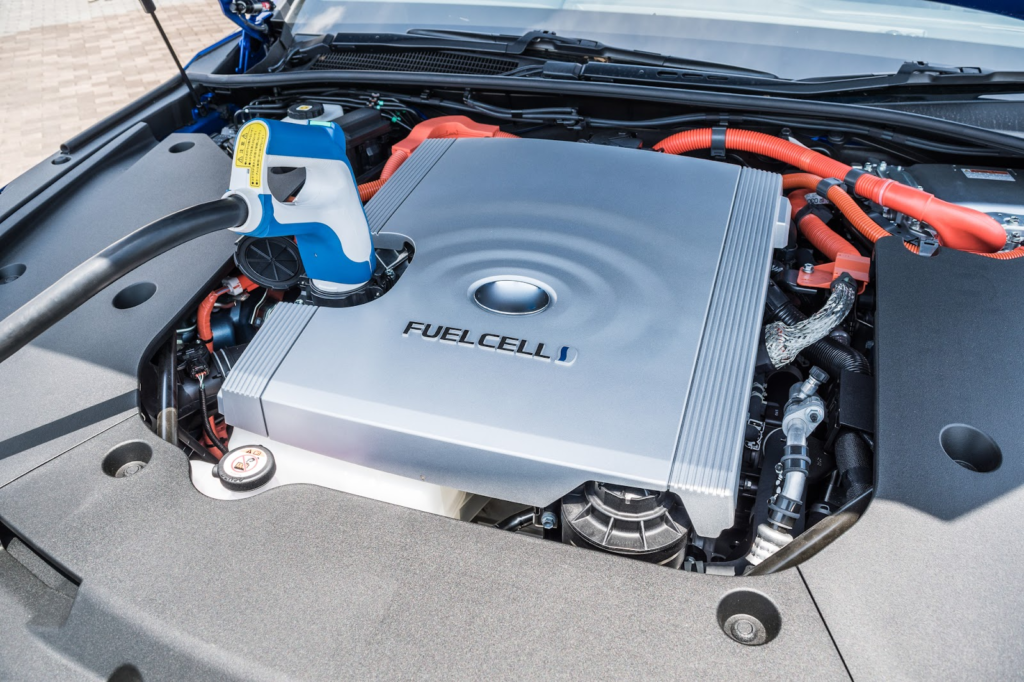
A fuel cell is a device that uses hydrogen and oxygen to produce electrical energy.
The image is of a ‘power generator’ that produces electricity through chemical reactions.
A fuel cell consists of three components: an anode (fuel electrode) to which hydrogen is supplied, a cathode (air electrode) to which oxygen is supplied and an electrolyte to which ions are transferred.
When hydrogen and oxygen are supplied to separate electrodes, electricity is generated by the fuel cell, and water and heat are produced as reaction products.
The main difference with traditional generators is that they do not emit carbon dioxide or nitrogen oxides when producing electricity.
This is why it has recently attracted attention as an environmentally friendly source of electricity.
Type
A fuel cell can be divided into five categories, depending on the type of electrolyte
- Polymer electrolyte fuel cell (PEFC)
- Phosphoric acid fuel cell (PAFC)
- Alkaline fuel cell (AFC)
- Molten carbonate fuel cell (MCFC)
- Solid oxide fuel cell (SOFC)
Each of them is explained one by one.
Polymer electrolyte fuel cell (PEFC)
PEFC uses a solid polymer membrane (ion-exchange membrane) as the electrolyte.
Power output is around 50 kW.
Operating temperatures range from room temperature to approx. 90 °C.
Power generation efficiency of 30-40%.
It is characterized by small and compact.
They are used in a variety of uses, including household, automotive and mobile equipment.
Phosphoric acid fuel cell (PAFC)
PAFC is characterized by the use of phosphoric acid (H₃PO₄) as the electrolyte.
The maximum power output is around 1000 kW and electricity is generated at approximately 200 °C.
Power generation efficiency is 30-40%.
It is possible to generate electricity on a relatively small scale.
It is used in hospitals, hotels, buildings and other commercial applications.
Alkaline fuel cell (AFC)
AFC uses alkaline electrolytes such as potassium hydroxide (KOH).
Power output ranges from a few kW to several hundred kW.
Operating temperatures range from room temperature to 150°C.
Power generation efficiency is 40-50%.
They deteriorate due to carbon dioxide in the air and fuel that require regular maintenance.
Suitable for use in enclosed spaces, e.g. for spacecraft and submarines.
Molten carbonate fuel cell (MCFC)
MCFC uses lithium carbonate (Li₂CO₃) or sodium carbonate (Na₂CO₃) as electrolyte and carbon monoxide as fuel in addition to hydrogen.
Operating temperature is approximately 650 °C.
Power output ranges from 1 to 100 000 kW.
Power generation efficiency is 50-60%.
As with the SOFC introduced next, no catalyst (e.g. platinum) is required for power generation.
It is used in a wide variety of applications, including industrial and power generation facilities.
Solid oxide fuel cell (SOFC)
SOFCs use stabilised zirconia (ZrO₂+Y₂O₃) as the electrolyte and carbon monoxide as well as hydrogen as fuel.
The operating temperature is approximately 1000 °C and the power output is between 1 and 100 000 kW.
Power generation efficiency is relatively high at 40-65%.
It is used in a wide variety of applications, including household and automotive applications.
Advantage

There are three advantages of fuel cell.
- Zero emission
- High power generation efficiency
- Flexible control over the amount of electricity generated
Each of these is explained one by one.
Zero emission
A fuel cell emits mostly water and heat.
No carbon dioxide is produced when electricity is generated, resulting in almost zero greenhouse gas emissions.
So it is receiving attention as a clean energy source with an extremely low environmental impact.
High power generation efficiency
Turning a turbine, as in thermal power generation, causes energy losses due to frictional heat and other factors.
On the other hand, a fuel cell is considerably more efficient than other methods of electricity generation, as electricity is obtained directly from a chemical reaction.
Efficiency can also be further increased by utilizing the heat from reaction by-products.
Flexible control over the amount of electricity generated
A fuel cell is only able to generate electricity as long as the fuel gas is supplied to the poles.
It is able to produce the required amount of electricity on a stable basis.
Disadvantage

Two disadvantages of fuel cell are as follows.
- High cost
- Hydrogen supply and storage issues.
Each of these is explained one by one.
High cost
Types requiring catalyst loading on the electrode surface (PEFC, PAFC, AFC) use expensive precious metals.
Therefore, compared to conventional generators, higher costs are incurred during the production of fuel cells.
Hydrogen supply and storage issues.
At present, hydrogen is produced through the reforming of fossil fuels and water electrolysis methods using renewable energy sources.
However, the supply is still insufficient for future hydrogen-based urban development.
In addition, there are unresolved technical issues in terms of container safety and weight when storing the produced hydrogen in or absorbing it.
The situation is such that there are many challenges to overcome for the widespread use of fuel cell.
Examples of use
A fuel cell is used to power vehicles and households.
Each of these is explained below.
Fuel-cell vehicle
A fuel cell vehicle is a car equipped with a fuel cell that runs on electricity generated by chemical reactions within the cell.
Unlike petrol-powered vehicles, it has the advantages of zero emissions and significantly faster filling times compared to electric vehicles.
Household electric generator
Recently, household fuel cells, such as Panasonic’s ENE・FARM, are gradually becoming more widespread.
Thanks to its high power generation efficiency, it helps reduce utility costs, and because it emits no greenhouse gases, it enables a lifestyle with a low environmental impact.
Lastly
This concludes the commentary on fuel cells.
We hope this will help to answer your questions.
References
燃料電池の種類 (tohoku.ac.jp)
燃料電池のしくみ・特徴|中国電力 (energia.co.jp)
燃料電池 – 環境技術解説|環境展望台:国立環境研究所 環境情報メディア (nies.go.jp)
燃料電池とは | エネファームとは | 家庭用燃料電池(エネファーム) | Panasonic
ホンダの新型燃料電池システム、生産性向上でコストを3分の1に | 日経クロステック(xTECH) (nikkei.com)
次世代エネルギー「水素」、そもそもどうやってつくる?|スペシャルコンテンツ|資源エネルギー庁 (meti.go.jp)
~特集~ 水素社会は本当に実現するのか (smfg.co.jp)