
Catalysts are rarely seen in everyday life.
We don’t realize it but they are used in many places.
In this article, we talk about catalysts used in cars.
In fact, catalysts are used in car and motorbike mufflers.
In this article, we will explain the catalysts used in cars (automotive catalysts), from their role to how they work.
Let’s have a look.
Catalysts used in cars convert toxic gases into harmless gases.
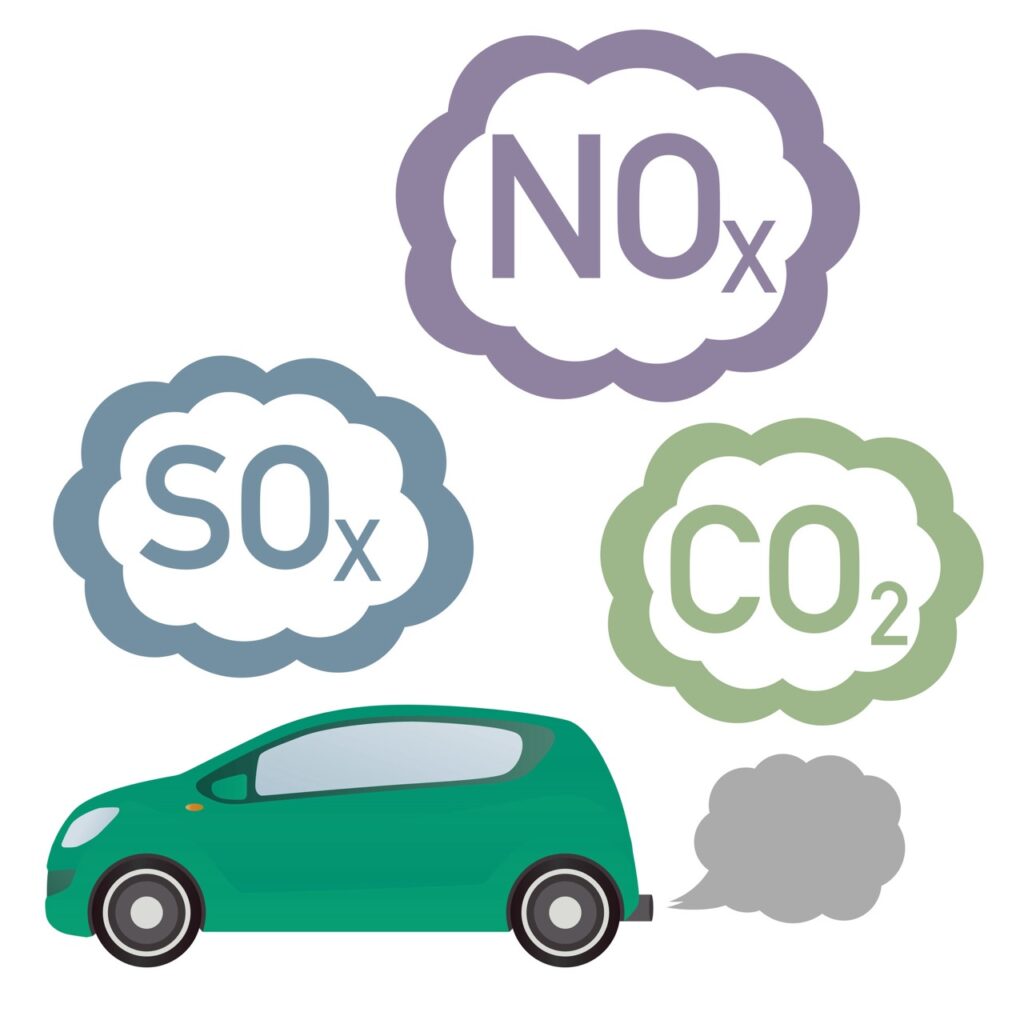
A catalytic converter used in cars (automotive catalytic converter) is a device that converts toxic gases, such as carbon monoxide and nitrogen oxides, into gases that are harmless to humans, such as carbon dioxide, nitrogen, and oxygen. It is used in the exhaust systems of cars and motorcycles.
There are two main types of automotive catalyst to look at.
There are two main types of catalyst used in cars

There are two main types of vehicle catalysts.
Let’s look at each of them.
three-way catalyst
Three-way catalysts are typical catalysts used in petrol vehicles and are ceramic or metallic honeycomb structures.
Rhodium, platinum and palladium are used as catalysts, converting toxic substances into harmless substances as the exhaust gases pass through.
NOx storage reduction catalyst
Three-way catalysts are not effective in lean burn engines (engines with a reduced proportion of petrol) and diesel engines.
NOx (nitrogen oxide) storage reduction catalysts are therefore used.
The mechanism is to absorb NOx emitted from the engine and purify it with a reductant supplied by the engine.
As they are more commonly used in petrol-powered vehicles, the following section details how three-way catalysts work.
Role and mechanism of catalysts used in cars (three-way catalysts).
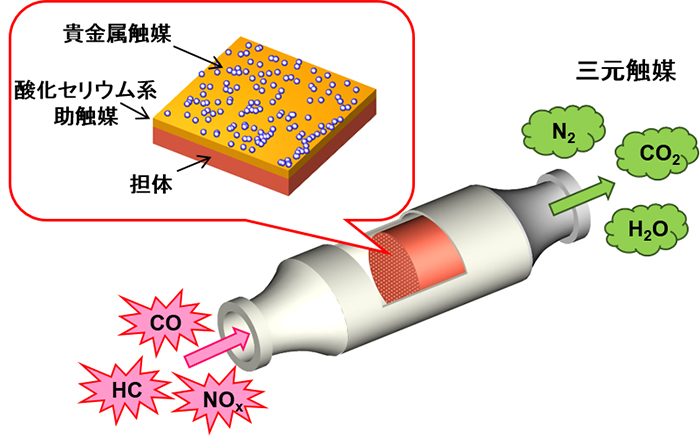
Source:新しい酸化セリウムナノロッド材料の開発 | AIMR
Catalytic converters contain “rhodium,” “platinum,” and “palladium”, which use catalytic reactions to neutralize toxic gases.
Specifically, the following chemical reactions detoxify the substance.
- HC (hydrocarbons) → oxidation → H2O + CO2 (water and carbon dioxide)
- CO (carbon monoxide) → oxidation → CO2 (carbon dioxide)
- NOx (nitrogen oxides) → reduction → N2 + O2 (nitrogen, oxygen)
Catalysts are needed for this ‘oxidation/reduction’.
Originally an essential part of the car, many catalysts have been used in the history of the automobile.
Let’s also look a little at the history of catalysts and automobiles.
History of catalysts and automobiles.

| Type of vehicle | Prices at the time (now reversed) | Catalytic performance | |
|---|---|---|---|
| Platinum catalyst | Diesel powered car | expensive | High |
| palladium catalyst | petrol engine car | Cheap | Low |
Platinum catalysts were originally used in many diesel vehicles.
Palladium catalysts are used in petrol vehicles.
The monetary value behind this was that palladium was cheaper than platinum.
Although palladium has lower performance as a catalyst, it is sufficient for petrol engines.
The price of palladium was cheap at the time, but now the price has skyrocketed due to increased demand for petrol-powered vehicles.
It is now more expensive than platinum and gold.
For this reason, many platinum catalysts are now used in petrol vehicles.
Furthermore, the automotive industry and platinum catalysts are inextricably linked, as platinum is also used as a catalyst in fuel cell vehicles that use hydrogen as their energy source.
Automotive catalysts are also explained in the following article, which may be of interest to you.

As an aside, Toyota was the first Japanese company to use a three-way catalyst system, which was installed in the Crown 2000 in 1977. (The three-way catalyst was invented in the USA in the early 1970s)
Summary
In this article, we explained the catalysts used in cars.
Let’s look back at the key points.
- Catalysts used in cars (automotive catalysts) convert toxic gases into non-toxic gases.
- Automotive catalysts can be divided into ‘three-way catalysts’ and ‘NOx storage reduction catalysts’ (three-way catalysts are more commonly used).
- Three-way catalysts include ‘rhodium’, ‘platinum’ and ‘palladium’ catalysts.
- Today, due to the rising price of palladium, many platinum catalysts are used in petrol-powered vehicles.
Other catalysts can be found in the following articles.