
The lead-acid battery was developed by Gaston Plante in France in 1859.
Since then, they have been used in a variety of situations, including car batteries and electric forklifts.
However, many people have probably heard of lead-acid batteries, but do not know much about them.
This article therefore describes lead-acid battery.
We hope that you will read this article to the end, as it explains how it works, its longevity and its shortcomings.
Let’s look at them.
What is a lead-acid battery?
Structure
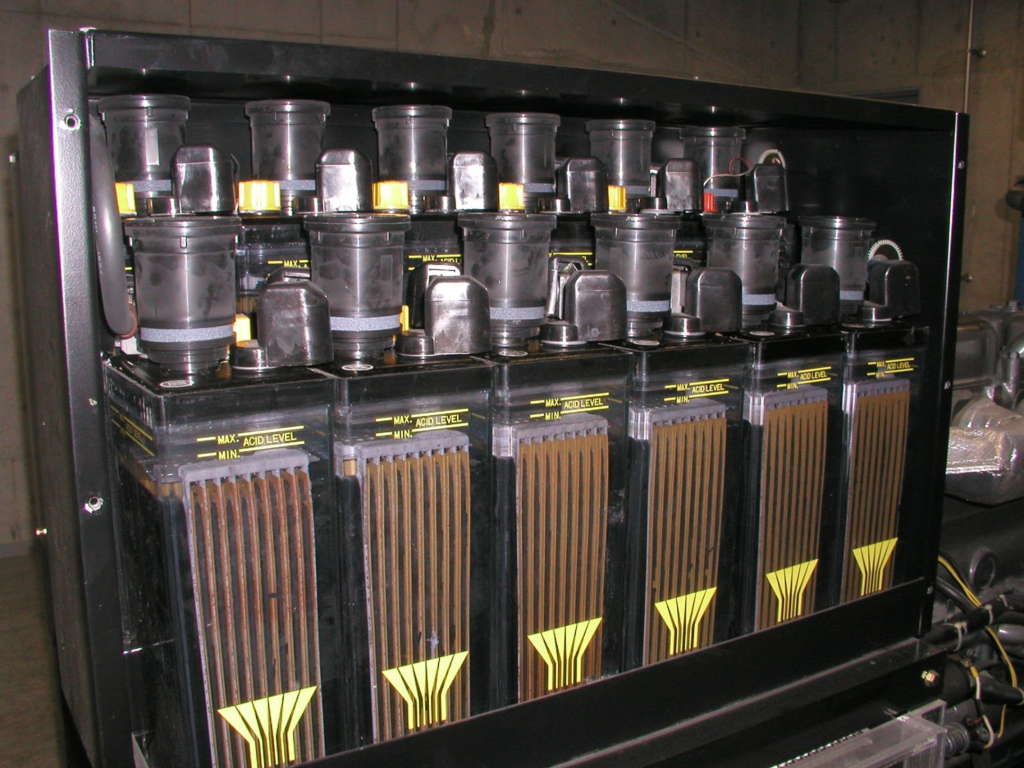
Lead-acid batteries are a type of rechargeable battery that can be charged and discharged.
Lead dioxide (PbO2) is used for the positive electrode, lead (Pb) for the negative electrode and dilute sulphuric acid (H2SO4) with a concentration of around 30 % for the electrolyte,
During charging, a reaction occurs in the cathode where the deposited lead sulphate (PbSO4) becomes lead dioxide, and in the anode where the lead sulphate becomes lead.
- positive electrode reaction: PbSO4 + 2H2O → PbO2 + H2SO4 + 2H+ + 2e−
- Negative electrode reaction: PbSO4 + 2H+ + 2e− → Pb + H2SO4
When lead sulphate is converted to lead dioxide and lead during charging, the oxidation number of lead changes from divalent to tetravalent and zero-valent.
However, lead is most stable in its divalent state, so the reverse reaction described above proceeds smoothly during discharge.
- positive electrode reaction: PbO2 + H2SO4 + 2H+ + 2e− → PbSO4 + 2H2O
- Negative electrode reaction: Pb + H2SO4 →PbSO4 + 2H+ + 2e−
Characteristic
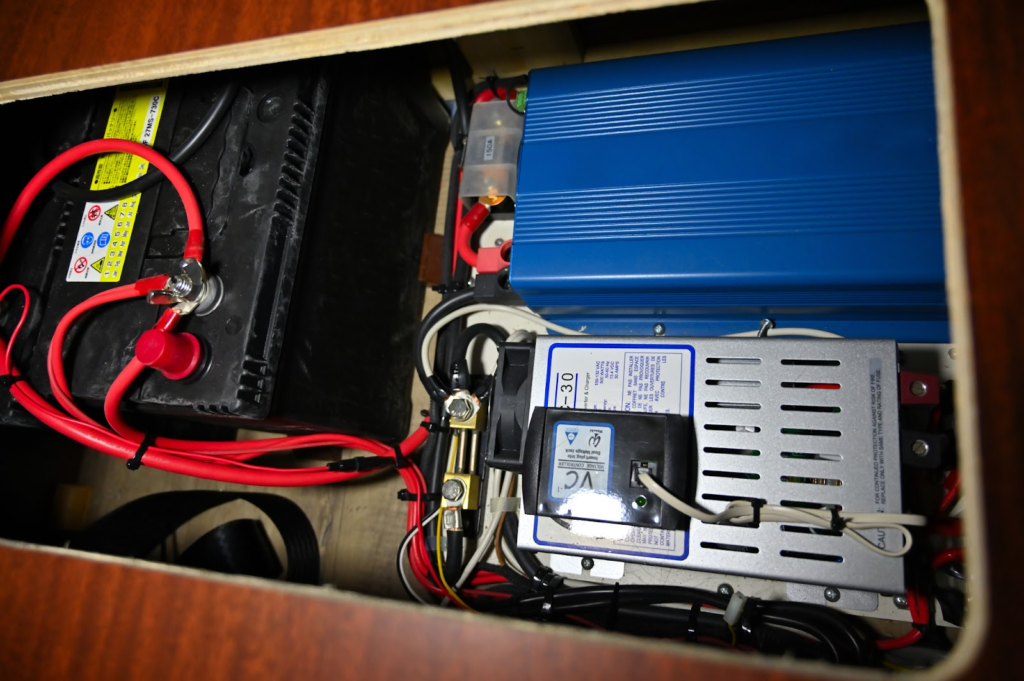
Lead-acid batteries have the following three characteristics
- Relatively high voltage per terminal
- Large current draw in a short time.
- Can be manufactured inexpensively
Each of these is explained one by one.
Relatively high voltage per terminal
The voltage per terminal is about 2 V.
Although it is inferior to lithium-ion batteries, which show voltages of 3 V or more, they show higher voltages when compared to nickel-metal hydride and nickel-cadmium batteries, which show voltages of around 1.2 V.
In situations where higher voltages are required, batteries are connected in series to gain voltage.
The higher the voltage per terminal, the fewer batteries are needed, which makes lead-acid batteries useful for car batteries that require a higher voltage.
Can be manufactured inexpensively
Lead in electrodes is a cheaply available metal.
The overall production price of the battery is lower, giving it a significant lead over other rechargeable batteries in terms of installation costs.
Recycling system in place.
More than 160 years have passed since its development in 1859, and a recycling system for electrodes is already in place.
It has more reusable components than other rechargeable batteries, making it an environmentally friendly rechargeable battery.
Life span

They gradually deteriorate as lead dioxide is stripped from the cathode during the charge-discharge reaction and water is lost through natural evaporation.
The lifespan of a lead-acid battery depends on the conditions of use, but is said to be around three years for motorbike and car batteries, and around 20 years for use as a backup power source.
If the battery is used in a way that damages it, such as overcharging or overdischarging, the number of usable cycles will be reduced.
To extend battery life, it is necessary to review the frequency and conditions of use.
Disadvantages of lead-acid battery
The three disadvantages of lead-acid batteries are as follows.
- Large in weight or volume
- High risk during rupture.
- Sulphation.
I will explain them one by one below.
Large in weight or volume
The high density of lead plates and lead oxide plates in the electrodes makes them heavier than other rechargeable batteries.
Also, as a result of the larger electrode area for higher currents, the volume of the battery covering it is also larger.
High risk during rupture.
The use of sulphuric acid as electrolyte poses a risk to human health in the event of a battery rupture or other external leakage of liquid.
They are designed to be robust to prevent leakage, but this also makes lead-acid batteries heavy.
Sulphation.
If a battery is not used for a long period of time or used without being fully charged, ‘sulphation’ occurs, where lead sulphate crystals form on the surface of the lead anode and form a layer.
The layer of lead sulphate covers the electrode, reducing the electrode surface area and making it difficult for electricity to flow during charging and discharging.
If the engine of a car that has not been driven for a long time is difficult to start, it is possible that this sulfation has occurred on the electrode surfaces.
This phenomenon is unique to lead-acid batteries and if the sulphation becomes severe, the battery has to be replaced as it is difficult to remove the lead sulphate layer.
examples of application
The first example of the use of lead-acid batteries is in car engine starting batteries.
They are also used for other purposes, such as a reserve power source for facilities in case of emergencies and disasters, and for storing renewable energy.
We don’t often actually see lead-acid batteries in our everyday lives
However, they underpin modern society in this unseen way.
Lastly
This concludes the commentary on lead-acid batteries.。
We hope that we can answer some of the many questions you may have about batteries.
References
鉛蓄電池について<バッテリーの基礎知識>|インフューズ (infuse-net.com)
電池の活躍の場 | 一般社団法人 電池工業会 (baj.or.jp)
3 鉛蓄電池 坪田正温. 電気化学, 59, 9, 746-752 (1991)
鉛のリサイクルプロセス 大石敏雄. まてりあ, 35巻第12号, 1303-1306 (1996)
鉛蓄電池の技術動向 広瀬 義和, 近藤 悟. 電気学会誌, 134巻11号, 758-761 (2014)